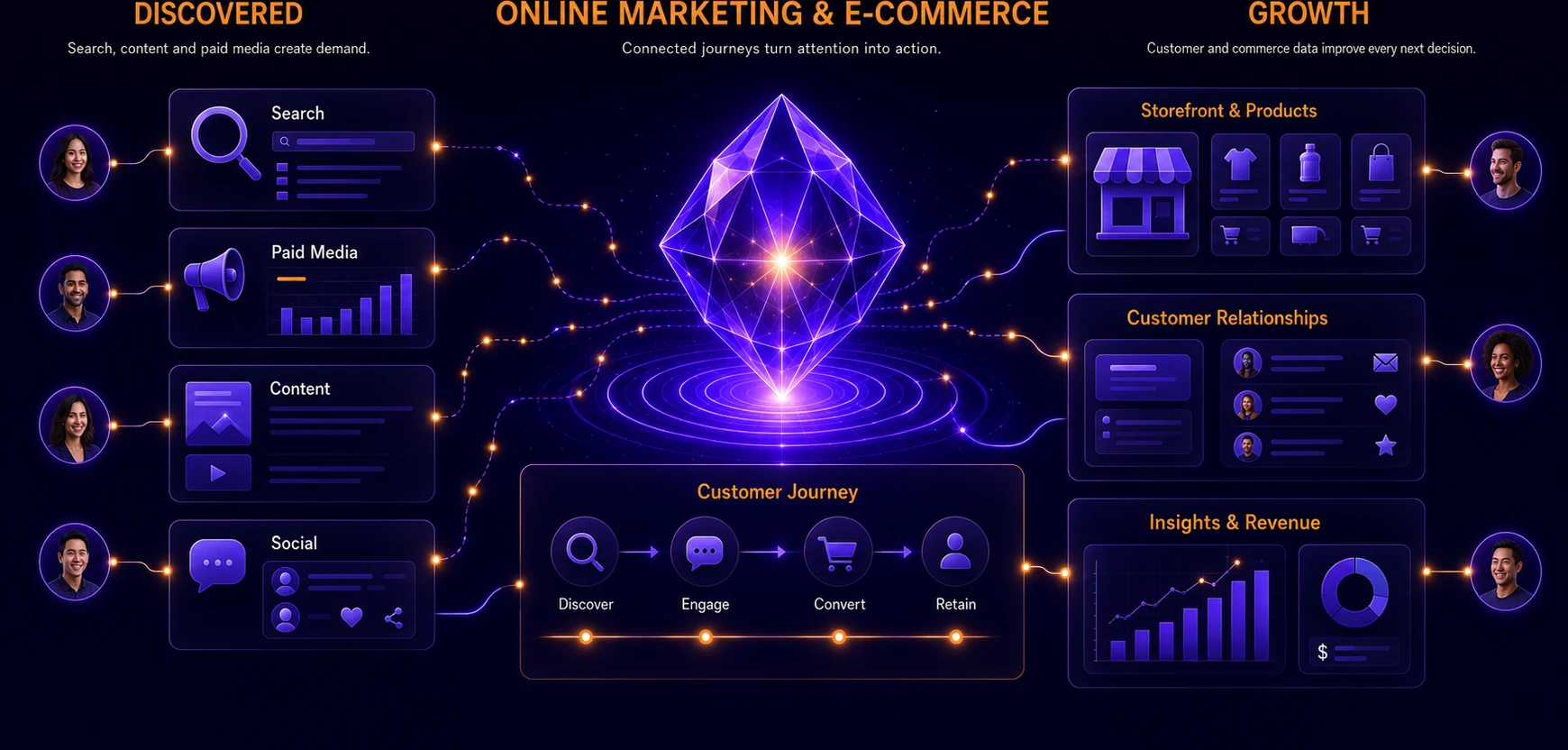
How do you integrate AI into your
marketing and e-commerce? Start here:
more efficient, faster, bigger ROI.
Small and medium service-oriented businesses and online shops in the e-commerce industry can benefit the most from marketing automation with AI. You can automate repetitive, analytical, and data-related activities, giving you more time to focus on providing the best possible service and products to your clients and customers.
If the descriptions above did not settle it, this usually does.
Ten plain questions about how customers find you, buy, and come back. You get the weakest link in that chain and the one thing to fix first.
Take the growth checkFree · three minutes · no registration · nothing leaves your browser
Skip the check and request a call instead. I look at your marketing and your shop, and you leave knowing where the first worthwhile move is.
You know AI matters. You do not know where to start, what is hype, and what would actually move your numbers. The audit answers that, with a prioritised 90-day roadmap, not a 50-page presentation nobody reads.
A fixed-scope review of your marketing and e-commerce operation, run by a senior practitioner, that ends with a clear, ordered list of where AI earns its keep first.
You are stuck between two bad options: do nothing while competitors move, or buy a tool on a vendor's promise and hope. The audit replaces both with an experienced read: what AI genuinely improves in your operation, what it cannot yet, and in what order.
I look at how your team actually works: content and campaign production, SEO, product pages, support load, reporting, the manual hours. I map each against what AI realistically delivers at your scale, and separate the high-leverage moves from the expensive distractions.
Mid-market e-commerce and marketing teams, roughly €2–20M revenue, without a senior, vendor-neutral read on where AI fits. If you want the cheapest pair of hands to build a bot, I am not your person. If you want judgment first, I am.
Direct with me, no junior team, no account manager. Fixed scope and price, agreed before we begin. You decide what happens next; no lock-in, no pressure to continue into a build.
Your customers no longer search in one place. They ask Google, they ask ChatGPT, they skim an AI-written summary, and they have shortlisted two providers before anybody picks up a phone. MetaGem finds what is holding your visibility back, in classic search and in AI answers alike, and hands you a prioritised plan for being found, understood and recommended.
A fixed-scope review of how findable you are, in classic search and in AI answers alike, ending with a prioritised plan for being found, understood and recommended.
Your customers no longer search in one place. They ask Google, they ask ChatGPT, they skim an AI-written summary, and they have shortlisted two providers before anybody picks up a phone. Meanwhile organic traffic has flattened and nobody can tell you exactly why, visitors arrive in reasonable numbers and very few become enquiries, and competitors keep surfacing in AI answers where your company does not appear at all.
Six areas, deliberately not split into an SEO project and an AI project: the same faults cause both, and paying twice to find them wastes your money. Technical foundations, meaning crawling, indexing, site structure, page speed and the mobile experience, the unglamorous layer that quietly limits everything above it. Content and search intent, whether your pages answer what buyers actually type, how they link to each other, and where thin or duplicated pages are competing with your own best work. Rankings, keywords and competitors, what you rank for, what you ought to rank for, and where the companies beating you are getting their authority from. AI search visibility testing, with real buyer questions run across the assistants your market uses, recording whether you are named, how accurately you are described, and who is cited instead. Entity and schema clarity, whether a machine can tell what your company is, what it sells and who it serves. And measurement and tracking, whether your analytics can even see AI referrals yet, and what to change so that next quarter’s numbers mean something.
Companies whose organic traffic has flattened or fallen without a clear explanation, who are about to commit to an SEO retainer, a content programme or an agency and want an independent read first, or who have inherited a website and need to know what state it is genuinely in. If you want a guaranteed position by a fixed date, nobody can honestly sell you that. If you are shopping for the cheapest possible link building or volume publishing with no editorial standard behind it, I am not your person. And if nobody on your side will have capacity to act on the findings for the next six months, the review will not help you yet.
Direct with me, fixed scope and price agreed before we begin. Read access only: nothing changes on your site during the review, so live traffic carries no risk. Discovery and access first, then the technical and content review, then visibility testing across the assistants, then prioritisation, and finally the report and a live walkthrough. The findings are yours to keep, whether the work that follows happens with me, with your existing agency, or in-house.
Budget going to the audiences, offers and actions that produce business, and reporting that shows you which ones did. MetaGem audits, rebuilds and runs campaigns across Google, Meta and LinkedIn.
Budget going to the audiences, offers and actions that produce business, and reporting that shows you which ones did. Audited, rebuilt and run across Google, Meta and LinkedIn.
You spend on ads every month and cannot see the return. The reports show impressions and clicks and say nothing about whether a lead was worth having. Somewhere in the account a few campaigns are carrying the whole thing while the rest quietly drain it, and without trustworthy tracking there is no way to tell which is which. Rebuilding on broken measurement produces numbers that are wrong in a new way, and it is easy to spend three months celebrating them.
Every engagement starts inside the account, not in a strategy document. Within a week you get three answers: what a qualified lead really costs, whether the tracking tells the truth, and which campaigns carry the account while the rest drain it. The account and tracking are reviewed before anything changes. Then structure, because structure is where the waste lives: most accounts need rebuilding around how you actually sell, with fewer campaigns, clearer budget lines and one measurable action each, after which optimisation becomes a small weekly job. If the account is genuinely healthy I will say so. Landing pages count as advertising too, because a campaign is only as good as the page it points at, and the most expensive accounts usually point at a page demanding a fifteen-field form before giving anybody a reason to care. Fixing that page is part of the work, not an upsell.
Businesses spending monthly on paid media who cannot see the return, or who suspect the account has drifted away from how they actually sell. Suited to Google, Meta and LinkedIn, each doing a different job. If you want somebody to keep the existing structure running unchanged, or you are looking purely for the lowest possible management fee, this is not the right engagement.
Direct with me, no junior team. It starts with the audit; ongoing work is available and never a condition of it. Your accounts, your data, your history: if we stop working together nothing is handed back or rebuilt, because nothing was held hostage. Scope and price agreed before we begin.
Enquiries your sales team can work with, not a list of downloads. MetaGem builds the whole path as one piece of work, campaign to content to landing page to follow-up, so the handovers between them stop losing people.
Enquiries your sales team can work with, not a list of downloads. The whole path built as one piece of work, campaign to content to landing page to follow-up, so the handovers between them stop losing people.
People arrive and almost nobody makes contact. Usually no single part is broken: the campaign is fine, the content is decent, the page exists and somebody set up a form. What fails is the joins between them, because each was built by a different person at a different time for a different purpose. The other common failure is a strategy phase that produces a document and stops, and a strategy nobody built is an expensive opinion.
Seven parts, built as one piece. Audience, offer and message: who the campaign speaks to, what it puts on the table, and the one sentence that has to land. Campaign content and copy, the pieces that carry it, written for the reader rather than for the algorithm. Landing page structure and copy, meaning one page, one decision, and no navigation inviting people to wander off halfway through. Lead magnets and decision-support assets, a guide, comparison, checklist or assessment that is genuinely worth an email address. Forms, tracking and conversion paths, asking for the right information, counting it correctly, and passing it on without a person retyping it. Email and CRM nurture sequences, the follow-up that runs in the days after somebody raises a hand, with a human handover point that is agreed rather than assumed. And campaign review and improvement: where people drop out, why, and what to change next, written down so the next campaign starts smarter.
Businesses getting traffic that does not turn into enquiries, or generating downloads that sales cannot do anything with. Best suited to companies with something genuinely worth putting on the table and somebody to follow up when the enquiries arrive. If what you want is a strategy document, or volume of leads regardless of whether sales can work them, this is not it.
Direct with me, scope and price agreed before we begin. What already works stays: decent content with a broken conversion path is common, and rebuilding what is fine is not a service, it is invoice-filling. The assets are written, not specified, and they are yours. The handover point where a person takes over is agreed rather than assumed.
MetaGem finds where customers hesitate, abandon or fail to return, then ranks the fixes by what each is worth to conversion, order value and repeat purchases. The cheapest growth is usually already in the funnel.
A review that finds where customers hesitate, abandon or fail to return, then ranks the fixes by what each is worth to conversion, order value and repeat purchases.
Your shop converts badly, or customers buy once and never come back, and the analytics do not make it obvious why. The cheapest growth is usually already in the funnel: customers you have already paid to attract, losing their nerve somewhere between the product page and the confirmation screen. The shop as a customer experiences it and the shop as your data records it disagree more than anyone expects, and the gap between them is where the opportunity sits.
The customer journey is walked properly first: landing, browsing, comparing, basket, hesitation, checkout, confirmation, delivery and the return visit. Each is a place to lose somebody, and each leaves a trace in the data. Then the checkout in detail, every field, step, surprise cost and moment of doubt, on phone and on desktop, because checkout is where customers you already paid for are lost, which makes it the most expensive place to ignore. The data is checked before any conclusion is written, since a recommendation built on a misconfigured event is worse than none, and broken measurement becomes roadmap item one. Everything found is then prioritised with effort attached: some of the best fixes are an afternoon of developer time, others are a replatforming project, and you deserve to know which is which before anybody starts.
Shops where conversion is below what the traffic deserves, average order value has stalled, or customers do not return. Works on Shopify, WooCommerce, Shopware and most others. If you want implementation without the diagnosis, or a redesign decided before the data has been looked at, this is the wrong starting point.
Direct with me, fixed scope and price agreed before we begin. Read access to the shop and analytics is all that is needed; nothing changes during the review. Implementation afterwards is optional and scoped separately, never a condition of the review.